- ...
- 3D SYSTEMS
- A&N Welding
- AA - Geen merkpagina
- ABA
- ABA Z&B
- Abb
- Abene
- ABUS
- Accut
- Accuway
- Aceti
- ADIGE
- Adira
- AFE
- AFM
- AGEO
- Agie
- Agiecharnilles
- AI HEMBRUG
- AIRHOUSE
- AKBEND
- Akira seiki
- AKYAPAK
- Alfra
- ALLMATIC
- Almi
- Alpha
- ALZMETALL
- AMADA
- Amc
- AMF Spanntechnik
- Amob
- ANAYAK
- ANDRITZ KAISER
- Angst
- Apec
- APOLLO
- ar iitalia
- ar italia
- Arcall
- ARD ART EDM
- Aris
- ARISTO
- Aritala
- ARKU
- ARKUS
- ARMSTRONG-BLUM
- Arntz
- ART Welding
- Arthur Klink
- ASQUITH
- Asquith butler
- Atkin
- Atlantic
- ATLAS
- Atomat
- Atron Germany
- Auerbach
- Auto well
- AVIA
- AVM
- AVM Angelini
- AWEA
- AXA
- AXZION
- BAD DUEBEN
- BAILEIGH
- BAKKER
- Barcorp
- Barnersdrill
- BAUER
- BAYKAL
- BEHRINGER
- Beka mak
- BEKAMAK
- BEND MOVE
- Bendmak
- Benzinger
- BERTHIEZ
- Beuter
- BEUTLER
- BEWO
- BEYELER
- Beyeler Mammut
- BIAX
- Biegenmaster
- Bieri AG
- Biglia
- BIGSTONE AUTOMATIC
- BIHLER
- BIKO
- Bilher
- BIMAK
- BINAR Sweden
- BIRLIK
- BISON Poland
- BLANSKO
- BLOHM
- BLUM
- BODE
- BOEHRINGER
- BOLDRINI
- BOLESTA
- Bolla
- Bollhof
- Bomar
- Boneham UK
- Bosch
- BOSCHERT
- BOST
- BOTT
- BPR
- Breda
- Breton
- Breuning
- BRIDGEPORT
- Brigeport
- BRISTOL
- Broadbent
- Brother
- BRUCKNER
- BuBend
- Buck
- Bucut
- BUISCAR
- Bullard
- Butler
- BWF
- BYSTRONIC
- C.P.S
- CABE
- Camu
- Cansa
- CARIF
- Carnaghi
- Casanova
- CAZENEUVE
- CBT
- CDMeccanica
- CEA
- Cematek
- CERATIZIT
- CERAZIZIT
- CETOS
- CEVISA
- CHARMILLES
- Cheto
- CHEVALIER
- Chinchmill
- CHIRON
- CIDAN
- Cinch mill
- Cinch-Mill
- CINCINNATI
- CIZETA
- CJM
- CKD
- CKD Blansko
- CLOOS
- CM Modena
- CME
- CMT
- Codatto
- COLCHESTER
- COLGAR
- COLLET
- COLLY BOMBLED
- COLOMBO & LENNA
- COMAC
- COMAL
- CombiPack
- COMESSA
- Comev
- CompAir
- Copren
- Cordia
- Cormac
- Cormak
- CORREA
- Correa Anayak
- Cosen
- Costa
- Cotek
- Crippa
- Crono
- CS Skates
- Csepel
- CT
- CTMS
- Cugir
- CUOGHI
- Cuteral
- Cybelec
- CyTec
- D'ANDREA
- DAEWOO
- DAEWOO DOOSAN
- Dahlih
- DAHLIH DCM
- Dainichi
- Daiss Partner
- Dalcos
- DANGO & DIENENTHAL
- Danieli
- DANOBAT
- DARLEY
- DATON
- Datron
- DAVI
- Davi Promau
- Deckel
- DECKEL MAHO
- Dees hydraulic
- DEGEN
- Delem
- Delken
- Delta
- DEMAG
- DEMMELER
- DEMOOR
- Dener
- DEPO
- DERATECH
- Desktop Metal
- Dimeco
- DIRINLER
- DMF
- DMG Gildemeister
- DMG MORI
- DMNC
- DMNC EDM
- DMT KERN
- DMTG
- DNR
- Doall
- Doganer makina
- Dominus
- DONAU
- DOOSAN
- DORMAC
- DORMAC DORIA
- DORRIES.
- DREISTERN
- DROOP & REIN
- DS Dorries Scharmann
- DS-Lifting
- DSK
- DTS
- DUGARD
- Dumeta
- DUNKES
- DUPLOMATIC
- DURMA
- Durmazlar
- DYNOBEND
- Dörries
- EBU
- ECKOLD
- ECOCA
- EDMO
- Edwards
- EIMELDINGEN
- Eisele
- Ekicontrol
- ELB
- ELB Schliff
- ELBO Controlli
- ELCORO
- ELIOG
- Elma
- ELMASS
- Elmatech
- Elsa
- ELUMATEC
- EMCO
- EMCO Famup
- EMP
- emsa
- Emsil
- ENERPAC
- Enshu
- EOS
- ERCOLINA
- ERGOMAN
- Erlo
- ERMAK
- ERMAKSAN
- ESAB
- Escomatic
- Esma
- ESS
- EST TICINO
- EUROMAC
- EUROMILL
- Everising
- Evisa
- Ewag
- EWM
- EWS
- EWU
- Exner
- FACCIN
- Fadal
- Fagima
- Fagor
- FAGOR Arrasate
- Faib
- FAMUP
- FANUC
- FARO
- Farrel
- FARROS
- FASTI
- FAT
- Fat (haco)
- Fat Wroclaw
- FAVRETTO
- Feeler
- Fehlman
- FEHLMANN
- Femco
- Ferex
- Fermat
- Fexac
- Fibro max
- FIL
- Fill
- Fim
- FINN POWER
- Finn-power
- FINNPOWER
- First
- Fischer
- Fives
- Flott
- FLOW
- FMB
- FMT
- FOERSTER
- Fokker Eckold
- Fonderia
- Foradia
- FOREST LINE
- FORKARDT
- Format
- Fornax
- FORTE
- FORTUNA
- FPS (DECKEL)
- FPT
- FptNews
- Fremtas
- Friggi
- FROEMAG
- Fromag
- FRONIUS
- FRORIEP
- Fulltontech
- Fumagalli Italia
- G. BREDA
- G.a.d.e
- G.B.C
- GabellaMacchine
- Gade
- Galileo
- GANRO Taiwan
- Garant
- GASPARINI
- GDW
- Gehring
- Geibel & Hotz
- GEKA
- Gelber-bieger
- GelberBieger
- Geldmacher
- GEMINIS
- Geminis Goratu
- Georg
- GEORGE KENDRICK
- Ger
- Gerardi
- GF Georg Fischer
- Giana
- Giddings&Lewi
- Giddings&Lewis
- GIETART
- GILDEMEISTER
- Gioria
- Giuseppe Giana
- Givi misure
- GksPerfekt
- Gleason
- GOCKEL
- GOLDEN SUN
- Gom
- GomMubea
- Goodway
- Govama
- Gpm titan
- GRAAF
- Graebener
- Graebner
- GRAFFENSTADEN
- GRESSEL
- Grindex
- Grit FEIN
- Grob
- Gs- hydro
- Gualdoni
- GUHRING
- Guifil
- Gurutzpe
- Gwf Mengele
- Gökcüoglu
- Haane
- Haas
- Habrama
- HACO
- HAEUSLER
- HAHN & KOLB
- HAIMER
- Handtmann
- Hankook
- Hannsa
- HAPREMEC
- Hardford
- Hardinge
- Hardinge Bridgeport
- Hare
- Harrison
- Hartford
- HAULICK ROOS
- Hawemat
- HBS Germany
- HDM
- Heatmasters OY
- Hebö
- Hedelius
- Hegenscheidt MFD
- Heidenhain
- Heinemann
- Heinrichsgluck
- HEINRICHSGLUECK
- Heller
- Hemburg
- Hemsaw
- HENNIGER --
- Henninger
- HERA
- Heraeus
- Herkules
- HERKULES WETZLAR
- HERMINGHAUSEN
- HERMLE
- Hestego
- HEXAGON
- HEYLIGENSTAEDT
- HGG
- Hifra
- HILMA
- HM
- HMC 500
- HNK
- Hochstrate
- HOEFLER
- HOESCH MFD
- Hofman
- Hofmann
- Hol-monta
- Holzmann
- Honor
- Hpm
- HSK
- Htt
- HUGH SMITH
- HURCO
- Hurco autobend
- HURON
- HWACHEON
- Hyd-mech
- Hyllus
- HYMO
- Hypertherm
- HYUNDAI
- HYUNDAI WIA
- HYWO
- Hänel
- Höfler
- I.m.a.l
- Ibarmia
- Iepco
- IGM
- IMAL
- IMATEC
- IMCAR
- IMET
- Ims
- Imsa
- INAXES
- INDUCTAFLEX
- Indumasch
- INNOCENTI
- Innse berard
- Innse berardi
- INNSE INNOCENTI
- INSITAN
- Intos
- INVERTER
- IRLE
- Isitan
- IXION
- JAEGER
- Jaespa
- Jafo
- Jagura
- Jakobsen
- Jammes
- Jap
- JBS
- Jenix
- JESSEY
- JET
- Jfmi
- Joen
- Johannsen
- Johansson
- Johnford
- JOHNFORDS
- JONES & SHIPMAN
- Jones- shipman
- JORNS
- Jorns ag
- Jouanel
- Juaristi
- JUNG
- JUNGENTHAL
- Junker
- Jutec
- Jörg
- Kaercher
- Kaeser
- KAISER
- KALTENBACH
- Kami
- KAMPA
- KAO FONG
- KAO MING
- Karl Deutsch
- KASTO
- Kasuga
- KAWASAKI
- Kawasaki robot
- Kef
- Kehren
- Keilinghaus
- Kekeisen
- KELLENBERGER
- KEMPPI
- Kent
- Keppler
- Kern
- Ki-Heung
- KIA Hyundai
- KIESERLING
- KiHEUNG
- Kimla
- King Rich
- Kingred
- KingRich
- KINGSLAND
- kipper trailer
- KIRA
- KISTLER
- KITAGAWA
- Kitchen walker
- KJELBERG
- Kjellberg
- Klaeger
- Klein
- Klemach
- Klingelnberg
- KNUTH
- Kohler
- KOIKE
- KOIKE ARONSON
- KOLB
- Koltech
- KONE
- KONECRANES
- KOVACO
- KOVOSVIT MAS
- Kramer
- Krewema
- Kromas
- KTS
- Kuhlmann
- Kuka
- KUMLA
- KUNZMANN
- Kurth+heuser
- L&W Machine Tools
- Lagun
- Lagun Goratu
- LAIP
- Lambert
- LAMBERT JOUTY
- LAMBERTINI
- Lang
- Lapmaster
- Lappmaster
- Lara
- Lauffer
- Lazzati
- Leadwell
- Legnani
- LEHMANN
- LEIFELD
- Leinen Swiss
- Leistitz
- Leistritz
- Leopoldo Pontiggia
- LGB
- LGB France
- LGM
- Licon
- Liebherr
- LIFT SIGMA
- LINCOLN
- LINDE
- LISSE
- Lissmac
- Loch
- Lockformer
- Loeser
- LORENZ
- Lovent
- LSK
- LTF
- LUCAS
- Lugong
- Lunan
- LUTZ
- LVD
- LVD STRIPPIT
- M&M
- M+A Maschinen
- M4M
- MAAG
- Machstroy
- MACMON
- MACO
- MACR
- Macri
- Macsoft
- MAEGERLE
- MAFI
- Magido
- MAHO
- MAHO GRAZIANO
- Make
- MAKEY BOWLEY
- Makino
- MANDELLI
- MAQFORT
- Marcovil
- MarioRiboldi
- MAS
- MAS Kovosvit
- Masima
- MATEC
- MATRA
- Matsuura
- Mavijet
- maxi horse trailer
- Maximart
- MAXION IXION
- MAZAK
- MazakVariaxis
- Mcm
- MEBA
- Meccanodora
- MECOF
- Memoli
- MEP
- Mepp
- Merli
- MESSER GRIESHEIM
- Metra
- MEWAG
- Mexpol
- MFD
- Mfl
- MG
- MGM
- MHG
- MIBA
- Micro abrasives
- MICROCUT
- Microcut Challenger
- Micromat
- Micromill
- Microstep
- Migatronic
- MIKRON
- Mikrosa
- Miller
- Millutensil
- Mios
- Mirfos
- MITSUBISHI
- Mitutoyo
- Miyano
- MODUL
- Modulift
- MOHR
- Mollart
- Monforts
- MORI SEIKI
- MOSSNER
- MTE
- Mtm
- MUBEA
- Muller BEM
- Muller Opladen
- Munk & Schmitz
- Muratec
- Mvd
- Myford
- Nagel
- NAKAMURA
- Namsung
- Narvik
- NAVICOR
- NAXOS UNION
- Nicolas Correa
- Nigata
- NIKI AG
- Nikken
- Niles-Simmons
- NISSAN
- Nissin
- NKO
- NKOmachines
- NOBLE & LUND
- Nobs
- NORMFINISH
- Nosstec
- Nova
- NOVISA
- Nukon
- Oemb
- OERLIKON AIR LIQUIDE
- OKAMOTO
- OKK
- Okuma
- Omag
- Omca
- Omcca
- OMERA
- Omes
- OML
- OPTIMUM
- ORT Italia
- Otc
- PADOVANI
- PAMA
- Paragon
- PARAT
- Parkson
- Parmigiani
- PBR
- PBR Legnano
- PBT
- PBT Indumasch
- PBT Walba
- PDG
- PEBA
- PEDDINGHAUS
- Pedrazzol
- Pedrazzoli
- PEE-WEE
- PEGARD
- Pegas
- Pehaka
- Pehu
- PEI-POINT
- Peiseler
- PEMA
- PEMAMEK
- Perfect
- Perndorfer
- PERNO SNC
- PETEWE
- Pfauter
- Pfeifer
- PICOT
- PIESOK
- Pietro Carnaghi
- PILOUS
- Pilous TMJ
- PINACHO
- PINNACLE
- Pittler
- Pivatic
- PLANK
- PLANOLITH
- PLEIGER
- PLYMOVENT
- POINTER
- POLYMAT
- POREBA
- POSCH AUSTRIA
- POTISJE
- Pratt & Burnerd
- PRATT BURNED
- PREMATEX
- Presse ROSS
- PresseRoss
- Prima
- Prima Power
- Prinzing
- Pro King
- Profiroll
- ProKing
- PROTH
- PROTON
- ProtoTRAK
- ProTurn
- PULLMAX
- PULLMAX KUMLA
- PUMA
- QUASER
- QuickTech
- R&D
- RABBA
- RAFAMET
- Rainer
- Rapid
- RAS
- RASKIN
- Raster
- Ravensburg
- Reckermann
- REFORM
- REFORM HEIDENHAIN
- Reiden
- Reiden Swiss
- REIS
- REISHAUER
- Rems
- RENISHAW
- Repar 2
- Retop
- Retos
- Retro AG
- Rettificatrici favretto
- Rettificatrici rosa ermando
- Richter Lunetten
- Ridgid
- Rivelica
- Robosoft
- Roccia
- Rofin
- ROHM
- Romi
- Rosa
- Rosa ermando
- Rosilio
- ROUNDO
- RSA
- RT WELDING
- RUCKLE
- RUEBENACH BONN BEUEL
- RUHRMANN PRESSEN
- Ryazan
- RÖSLER
- Rüsch
- Saacke
- SABI
- Sachman
- Sachmann
- SACHMANN RAMBAUDI
- Sack Kiesselbach
- Sacma
- SAF
- SAF Curvatrici
- SAF Kjellberg
- SAF Tauring
- SAFAN
- SAFAN DARLEY
- SAFOP
- SAHINLER
- SAHM SPLICE
- Salvagnini
- Samag
- SAMCHULLY
- SANDVIK COROMANT
- SANGIACOMO
- SanRocco
- Saro
- SARTORE
- SASS TORINO
- Sasta
- Sato
- Sauter
- Saymak
- Scantool
- SCHAEFER
- SCHAERER - FACING
- SCHARMANN
- SCHAUBLIN
- Schaudt
- Schechtl
- Scherer
- SCHIESS
- SCHIESS FRORIEP
- Schlebach
- Schleiffstein
- SCHLEIFSTEIN
- Schmaltz
- SCHNEEBERGER
- Schnutz
- SCHRODER FASTI
- SCHROEDER
- Schröder
- SCHUBERT
- SCHUNK
- Schwarze
- Schwarze Robitec
- Schwarze Wirtz
- Schwarze-Robitec
- SciTeex
- Scudding
- SDT
- Sedin
- Seiger
- SENY
- SEPI SOUDAGE
- SEPO
- Sergi
- Seroma
- SERRMAC
- Sertom
- SHUIPO
- Shuztung
- Shw
- Sicmi
- Siemens
- Siemens toolcabinet
- Simasv
- SIMAVS
- SIMEK
- Simerom
- SKODA
- Skymaster
- Smd
- Smec
- SMEC SAMSUNG
- SMT Schleifstein
- Smtcl
- Smv
- SMW AUTOBLOK
- Sng
- SNIJSTAAL
- SNK
- SOCAD
- Sodick
- Soenen
- Soitaab
- Somo
- Sony
- SORALUCE
- Spark
- SPINNER
- Spiro
- Spühl
- STAHLI
- STAKO
- STAMA
- STANKO
- Stankoimport
- STARTRITE
- Steiner
- STIERLI
- Stierli Bieger
- STILL
- Stilmec
- STOLLE
- STOLTING
- STOPA
- Storebro
- Stuckmann & Hillen
- STUDER
- STYLE
- Stöckel
- Stöling
- Suce
- SUHNER
- SunFirm
- SUNNEN
- Super KIA TURN
- Super plasma
- Supermax
- Suprema
- Swl
- T-DRILL
- T-SLOT
- Tacchella
- Tacchi
- TADU
- TAH
- TaianHualu
- TAILIFT
- Taipu
- Taisei
- Tajmac-Zps
- TAKANG
- TAKISAWA
- Taksan
- Takumi
- Talurit
- Tam
- Tauring
- Taurus
- Taurus Wotan
- Tbt
- TBT Tiefbohrtechnik
- Tci
- TCS
- TDG Spain
- TDG Solutions
- Teap
- TECHNICA
- TECHNOMAGNETE
- Tecnocut
- TecnoMagnet
- TECNOMAGNETE
- Tecnostamp
- Tecoi
- TEHAG
- Tenova
- TENSOL
- TENSOL OEMB
- TESA
- Thiel
- THIELER
- THOMAN
- Tibo
- Timac
- Timesavers
- TIRA
- TITAN
- Titanroman
- TMJ
- Tnw
- Tomac
- TONG-IL
- TONGTAI
- TOP-TURN Taiwan
- TOPPER
- Tornos
- TOS
- TOS Hostivar
- TOS Trencin
- TOS TRENS
- TOS VARNSDORF
- TOSHULIN
- TOSKAR
- TOYODA
- Toyota
- Tracto
- Tracto Technik
- TRAK
- Transfluid
- Transnorm System
- TRAUB
- TRENNJAEGER
- Trens
- Trepel
- Trevisan
- Triumph
- trolleys
- TroTec
- TRUMPF
- TRUMPF EHT
- TSCHUDIN
- TTS
- TUBOMAT
- TURNCRAFT
- Twin Seam
- UKB
- Umac
- Umaro
- Ungerer
- Uni-TECH
- UNION
- UNION HECKERT
- Unisig
- Unisign
- Urpe
- Ursus
- Ursviken
- Utas
- Uzay
- Uzma
- VacuLift
- Valdarno
- Variobend
- VDF
- VDF BOEHRINGER
- VDF Wohlenberg
- VEGO
- VERACHTERT
- VETTER
- VICTOR
- Victor Taichung
- VictorTaichung
- Vigel
- Viking
- Vimercati
- Vingriai
- VIPER
- VLM
- Voest Alpine
- VOESTALPINE
- VOGT Swiss
- VOLZ
- Voortman
- Wafios
- Wafois
- WAGNER
- Walba
- Waldrich
- Waldrich Coburg
- WALDRICH SIEGEN
- Walker Hagou
- WALTER
- Walter Eckold
- Walter Meier AG
- Warcom
- Waterjet
- Webster&bennet
- Webster&Bennett
- WECO
- Weeke
- Weidenmann
- WEILER
- WEILER MAS
- Weingärtner
- WEIPERT
- Weisser Heilbronn
- WELE
- Wema
- Wemas
- Wendt
- Wenzel
- Westekemper
- WF
- WFL
- WFL Austria
- Wila
- Wisconsin
- WJS
- WK IndustrieTechnik
- WMW
- WMW DESSAU
- WMW Heckert Meuselwitz
- WMW Meuselwitz
- WMW Zeulenroda
- WMZ
- WOHLENBERG
- Woochang
- Wortelboer
- WORTELBOER HOLLAND
- Wotan
- WOTAN SACEM
- Wuhan
- Wuxi Runyuan
- WZ
- XYZ Printing
- YAM
- YANG
- Yawei
- YC superjet
- YC Taichnung Taiwan
- YCM
- YCM Supermax
- Yoga
- YOU JI
- YOUji
- YSD
- YSP
- YU SHINE
- Zani
- ZAYER
- ZDAS
- Zdaz
- ZERBST
- Zeulenroda
- Ziersch
- Ziersch & Baltrusch
- Zimmerman
- Zmm
- ZMM Sliven
- Zocca
- Zoller
- ZOP BEND
- Zopf
- Zps
- Zymt
- Home
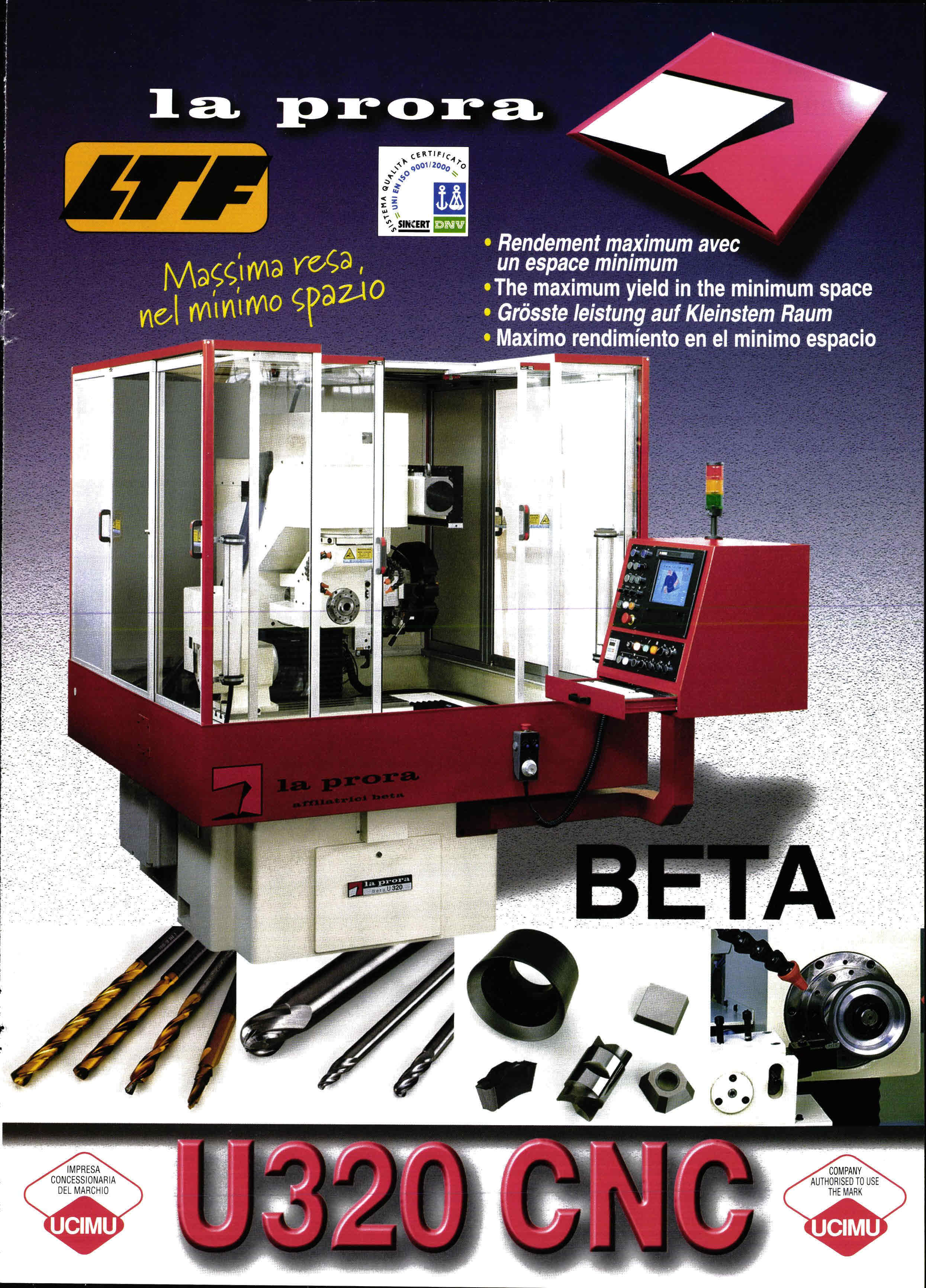
- LTF La Prora U 320 CNC milling machine
LTF La Prora U 320 CNC milling machine
LTF La Prora U 320 CNC milling
Company Authorized to Use the Mark
Characteristics and Details
The machine is mounted on a monobloc base that supports the two linear X and Z axes, the fixed column of the Y axis, and the cabin containing the coolant reservoir. The head of the motor carrier is above the two X and Z axes and pivots in the horizontal plane. The motor spindle has a power rating of 13.5 kW (10 HP) at 10,500 rpm and an adjustable speed range from 2,000 to 12,000 rpm.
The new typology of its traversing movements makes this machine so versatile that it can be used as a forming machine for all effects. Despite its capabilities, the machine has limited overall dimensions, just slightly larger than the current U95 model.
Equipment
It will be supplied with the following standard or optional equipment:
Wheel change with a 6-wheel magazine (optional)
Piece loader (optional)
Complete NUMROTOplus Software (standard)
Special slot for inserts
Machine Design
The machine is linked to a modular CNC system consisting of a central unit and control panel with an integrated keyboard and mouse. The concept of only one model of the machine makes it possible to build two versions: one with 5 axes and one with 6 axes.
Integrated Personal Computer
Characteristics of the integrated Personal Computer:
CPU and power supply compatible with ATX specifications
Microprocessor: Pentium or equivalent, minimum 166 MHz
Hard disk: minimum capacity of GB
3.5" Floppy Disk drive, accessible from the front panel and protected
Monitor: 10.4" TFT active matrix, high resolution 640 x 480 pixels color LCD, meeting the manufacturer’s technical specifications
Motion and Control
The traversing of all the linear axes is done through ball bearing screws, controlled by brushless AC motors.
Slideways on sliding blocks are preloaded with ball bearings for higher and more reliable performance over time.
Millesimal resolution of all axes.
Operational noise level: 60 dB.
Rotating wheelhead.
Automated wheel and magazine change.
The Spaces
As can be seen in photo 1, the wheel moves with respect to the piece to be milled in a very limited volumetric space of 1-2 dm³. This characteristic feature allows for traversing movements in very restricted areas, extremely quickly, and consequently with extremely high precision.It is controlled by the appropriate special programs, already integrated into the NUMROTOplus software, or through other specialized programs created by us. These programs are capable of determining the position and the form of the pieces to be milled, especially for regrinding operations. The feeler pin is expressly selected for each specific job from the various available forms, which have been previously studied by our technicians.Automatic Wheel Change
The quick-fit attachment, controlled by the PLC integrated into the motor spindle, has enabled the application of this accessory, which we consider to be of great utility. This optional feature, fully managed by the PLC, addresses three important and longstanding issues faced by tool manufacturers:Elimination of Operator Intervention: This feature allows for the elimination of the need for operator intervention when changing the wheel, thus saving machine downtime and time.
Elimination of Coaxial Wheel Trains: By eliminating the train of three coaxial wheels, which often cause collision problems and speed incompatibility, this feature allows work to be carried out with one or, at most, two wheels.
The automatic wheel changeThe quíckfít of the motor spíndle, linked to the PLC, has made ít possibie
to mount this accessory on the machine whích we belíeve to be extremely
useful.
With the total management of the thís optíonal makes it possíble to
resolve three important and age-old problems for the manufacturer s of
machíne tools.
1 Exclusion of operator íntervention to change wheels savings on machine
stoppages and therefore on tíme .
2 Exclusion of the coaxial three wheel train which often causes problems
of collísíon and speed íncompatíbility; in other words, it makes it possible
to work wíth one or two wheels at the most.
3 A notable economíc saving on the wheel store and wheelholders it is
not necessary to have packs of wheels ready for one use only in store .
In the magazíne, wíth 6 statíons, síx síngle wheels or síx couples of wheels,
with a maximum díameter of 150 mm. can be housed.
The system ís equípped with 4 atm blow pressure, for cleaning the cones
both on the motor and on the magazine at each change.
6 axis
Sixth Axis Application in Milling Machine
Description of the Sixth Axis Attachment
Introduction: Photo 2 illustrates the addition of a sixth axis, denoted as C, to the milling machine. This axis allows for the inclination of any tool secured in the tool clamp within the vertical plane.
Functionality: The sixth axis enables the execution of specialized milling operations requiring three distinct angles on three different surfaces. It leverages its specific housing alignment with axis A, as depicted in photo 1.
Versatility: This additional equipment can be seamlessly attached to or detached from axis A without compromising the machine's ability to perform other milling tasks.
Storage: After removal from axis A, the accessory can be securely housed on the machine's side, ensuring protection during other machining operations.
Visual Examples: Photos 2 below illustrate various tasks achievable with the Sixth Axis, highlighting its diverse capabilities in enhancing milling operations.
Detailed Benefits and Applications
Enhanced Capability: The inclusion of the Sixth Axis significantly expands the machine's versatility, allowing for complex milling tasks that demand multiple rake angles.
Precision and Flexibility: Operators can adjust tool angles precisely in the vertical plane, facilitating intricate machining operations with high accuracy.
Ease of Integration: Its design ensures straightforward integration with existing milling setups, complementing rather than hindering other machining processes.
Protective Storage: The machine's design accommodates safe storage of the Sixth Axis when not in use, safeguarding the equipment from damage during regular operations.
Conclusion
The addition of the Sixth Axis to the milling machine enhances its functionality, enabling sophisticated milling operations that require precise angular adjustments. This capability underscores the machine's adaptability to diverse machining requirements, ensuring efficient and accurate production across various applications.
Specialized Software and Peripheral Grinding Capabilities
Machine Customization and Software Integration
English:
Introduction: The machine is versatile enough to be equipped with specialized software designed for the peripheral grinding of inserts, as depicted in Photo 3.
Peripheral Grinding: It can perform peripheral grinding tasks on inserts of various shapes and forms, enhancing its utility across different manufacturing requirements.
Client Collaboration: Upon client request and collaboration, custom programs can be developed to execute diverse machining tasks. For instance, in Photo 3, a specialized tool for cutting paper is demonstrated.
Tool Flexibility: The machine's capabilities are showcased in Photo 4, where it is seen working with dedicated tools designed for specific applications.
Optimal Performance: Utilization of features like wheel change capabilities and motor spindle efficiency ensures effective grinding operations. The machine operates at speeds ranging from 2,000 rpm for external grinding to 24,000 rpm for internal grinding, maximizing productivity and precision.
Application Examples and Machine Capabilities
Versatility: With its ability to handle various tooling and software configurations, the machine adapts to different manufacturing needs, from paper cutting tools to intricate insert grinding.
Precision and Efficiency: The integration of specialized software and tools demonstrates the machine's capability to achieve high precision and efficiency in machining tasks.
Tailored Solutions: By collaborating closely with clients, bespoke machining programs can be devised to meet specific production demands, ensuring optimal performance and quality.
Continuous Improvement: The machine's design facilitates continuous improvement and adaptation, allowing for upgrades and enhancements as technology and production requirements evolve.
Conclusion
The machine's integration with specialized software and dedicated tools for peripheral grinding exemplifies its versatility and adaptability in modern manufacturing environments. Collaborative efforts with clients enable tailored solutions that enhance operational efficiency and meet unique production challenges effectively. This ensures that the machine remains at the forefront of precision machining, capable of delivering consistent and high-quality results across diverse applications.
LTF