- ...
- 3D SYSTEMS
- A&N Welding
- AA - Geen merkpagina
- ABA
- ABA Z&B
- Abb
- Abene
- ABUS
- Accut
- Accuway
- Aceti
- ADIGE
- Adira
- AFE
- AFM
- AGEO
- Agie
- Agiecharnilles
- AI HEMBRUG
- AIRHOUSE
- AKBEND
- Akira seiki
- AKYAPAK
- Alfra
- ALLMATIC
- Almi
- Alpha
- ALZMETALL
- AMADA
- Amc
- AMF Spanntechnik
- Amob
- ANAYAK
- ANDRITZ KAISER
- Angst
- Apec
- APOLLO
- ar iitalia
- ar italia
- Arcall
- ARD ART EDM
- Aris
- ARISTO
- Aritala
- ARKU
- ARKUS
- ARMSTRONG-BLUM
- Arntz
- ART Welding
- Arthur Klink
- ASQUITH
- Asquith butler
- Atkin
- Atlantic
- ATLAS
- Atomat
- Atron Germany
- Auerbach
- Auto well
- AVIA
- AVM
- AVM Angelini
- AWEA
- AXA
- AXZION
- BAD DUEBEN
- BAILEIGH
- BAKKER
- Barcorp
- Barnersdrill
- BAUER
- BAYKAL
- BEHRINGER
- Beka mak
- BEKAMAK
- BEND MOVE
- Bendmak
- Benzinger
- BERTHIEZ
- Beuter
- BEUTLER
- BEWO
- BEYELER
- Beyeler Mammut
- BIAX
- Biegenmaster
- Bieri AG
- Biglia
- BIGSTONE AUTOMATIC
- BIHLER
- BIKO
- Bilher
- BIMAK
- BINAR Sweden
- BIRLIK
- BISON Poland
- BLANSKO
- BLOHM
- BLUM
- BODE
- BOEHRINGER
- BOLDRINI
- BOLESTA
- Bolla
- Bollhof
- Bomar
- Boneham UK
- Bosch
- BOSCHERT
- BOST
- BOTT
- BPR
- Breda
- Breton
- Breuning
- BRIDGEPORT
- Brigeport
- BRISTOL
- Broadbent
- Brother
- BRUCKNER
- BuBend
- Buck
- Bucut
- BUISCAR
- Bullard
- Butler
- BWF
- BYSTRONIC
- C.P.S
- CABE
- Camu
- Cansa
- CARIF
- Carnaghi
- Casanova
- CAZENEUVE
- CBT
- CDMeccanica
- CEA
- Cematek
- CERATIZIT
- CERAZIZIT
- CETOS
- CEVISA
- CHARMILLES
- Cheto
- CHEVALIER
- Chinchmill
- CHIRON
- CIDAN
- Cinch mill
- Cinch-Mill
- CINCINNATI
- CIZETA
- CJM
- CKD
- CKD Blansko
- CLOOS
- CM Modena
- CME
- CMT
- Codatto
- COLCHESTER
- COLGAR
- COLLET
- COLLY BOMBLED
- COLOMBO & LENNA
- COMAC
- COMAL
- CombiPack
- COMESSA
- Comev
- CompAir
- Copren
- Cordia
- Cormac
- Cormak
- CORREA
- Correa Anayak
- Cosen
- Costa
- Cotek
- Crippa
- Crono
- CS Skates
- Csepel
- CT
- CTMS
- Cugir
- CUOGHI
- Cuteral
- Cybelec
- CyTec
- D'ANDREA
- DAEWOO
- DAEWOO DOOSAN
- Dahlih
- DAHLIH DCM
- Dainichi
- Daiss Partner
- Dalcos
- DANGO & DIENENTHAL
- Danieli
- DANOBAT
- DARLEY
- DATON
- Datron
- DAVI
- Davi Promau
- Deckel
- DECKEL MAHO
- Dees hydraulic
- DEGEN
- Delem
- Delken
- Delta
- DEMAG
- DEMMELER
- DEMOOR
- Dener
- DEPO
- DERATECH
- Desktop Metal
- Dimeco
- DIRINLER
- DMF
- DMG Gildemeister
- DMG MORI
- DMNC
- DMNC EDM
- DMT KERN
- DMTG
- DNR
- Doall
- Doganer makina
- Dominus
- DONAU
- DOOSAN
- DORMAC
- DORMAC DORIA
- DORRIES.
- DREISTERN
- DROOP & REIN
- DS Dorries Scharmann
- DS-Lifting
- DSK
- DTS
- DUGARD
- Dumeta
- DUNKES
- DUPLOMATIC
- DURMA
- Durmazlar
- DYNOBEND
- Dörries
- EBU
- ECKOLD
- ECOCA
- EDMO
- Edwards
- EIMELDINGEN
- Eisele
- Ekicontrol
- ELB
- ELB Schliff
- ELBO Controlli
- ELCORO
- ELIOG
- Elma
- ELMASS
- Elmatech
- Elsa
- ELUMATEC
- EMCO
- EMCO Famup
- EMP
- emsa
- Emsil
- ENERPAC
- Enshu
- EOS
- ERCOLINA
- ERGOMAN
- Erlo
- ERMAK
- ERMAKSAN
- ESAB
- Escomatic
- Esma
- ESS
- EST TICINO
- EUROMAC
- EUROMILL
- Everising
- Evisa
- Ewag
- EWM
- EWS
- EWU
- Exner
- FACCIN
- Fadal
- Fagima
- Fagor
- FAGOR Arrasate
- Faib
- FAMUP
- FANUC
- FARO
- Farrel
- FARROS
- FASTI
- FAT
- Fat (haco)
- Fat Wroclaw
- FAVRETTO
- Feeler
- Fehlman
- FEHLMANN
- Femco
- Ferex
- Fermat
- Fexac
- Fibro max
- FIL
- Fill
- Fim
- FINN POWER
- Finn-power
- FINNPOWER
- First
- Fischer
- Fives
- Flott
- FLOW
- FMB
- FMT
- FOERSTER
- Fokker Eckold
- Fonderia
- Foradia
- FOREST LINE
- FORKARDT
- Format
- Fornax
- FORTE
- FORTUNA
- FPS (DECKEL)
- FPT
- FptNews
- Fremtas
- Friggi
- FROEMAG
- Fromag
- FRONIUS
- FRORIEP
- Fulltontech
- Fumagalli Italia
- G. BREDA
- G.a.d.e
- G.B.C
- GabellaMacchine
- Gade
- Galileo
- GANRO Taiwan
- Garant
- GASPARINI
- GDW
- Gehring
- Geibel & Hotz
- GEKA
- Gelber-bieger
- GelberBieger
- Geldmacher
- GEMINIS
- Geminis Goratu
- Georg
- GEORGE KENDRICK
- Ger
- Gerardi
- GF Georg Fischer
- Giana
- Giddings&Lewi
- Giddings&Lewis
- GIETART
- GILDEMEISTER
- Gioria
- Giuseppe Giana
- Givi misure
- GksPerfekt
- Gleason
- GOCKEL
- GOLDEN SUN
- Gom
- GomMubea
- Goodway
- Govama
- Gpm titan
- GRAAF
- Graebener
- Graebner
- GRAFFENSTADEN
- GRESSEL
- Grindex
- Grit FEIN
- Grob
- Gs- hydro
- Gualdoni
- GUHRING
- Guifil
- Gurutzpe
- Gwf Mengele
- Gökcüoglu
- Haane
- Haas
- Habrama
- HACO
- HAEUSLER
- HAHN & KOLB
- HAIMER
- Handtmann
- Hankook
- Hannsa
- HAPREMEC
- Hardford
- Hardinge
- Hardinge Bridgeport
- Hare
- Harrison
- Hartford
- HAULICK ROOS
- Hawemat
- HBS Germany
- HDM
- Heatmasters OY
- Hebö
- Hedelius
- Hegenscheidt MFD
- Heidenhain
- Heinemann
- Heinrichsgluck
- HEINRICHSGLUECK
- Heller
- Hemburg
- Hemsaw
- HENNIGER --
- Henninger
- HERA
- Heraeus
- Herkules
- HERKULES WETZLAR
- HERMINGHAUSEN
- HERMLE
- Hestego
- HEXAGON
- HEYLIGENSTAEDT
- HGG
- Hifra
- HILMA
- HM
- HMC 500
- HNK
- Hochstrate
- HOEFLER
- HOESCH MFD
- Hofman
- Hofmann
- Hol-monta
- Holzmann
- Honor
- Hpm
- HSK
- Htt
- HUGH SMITH
- HURCO
- Hurco autobend
- HURON
- HWACHEON
- Hyd-mech
- Hyllus
- HYMO
- Hypertherm
- HYUNDAI
- HYUNDAI WIA
- HYWO
- Hänel
- Höfler
- I.m.a.l
- Ibarmia
- Iepco
- IGM
- IMAL
- IMATEC
- IMCAR
- IMET
- Ims
- Imsa
- INAXES
- INDUCTAFLEX
- Indumasch
- INNOCENTI
- Innse berard
- Innse berardi
- INNSE INNOCENTI
- INSITAN
- Intos
- INVERTER
- IRLE
- Isitan
- IXION
- JAEGER
- Jaespa
- Jafo
- Jagura
- Jakobsen
- Jammes
- Jap
- JBS
- Jenix
- JESSEY
- JET
- Jfmi
- Joen
- Johannsen
- Johansson
- Johnford
- JOHNFORDS
- JONES & SHIPMAN
- Jones- shipman
- JORNS
- Jorns ag
- Jouanel
- Juaristi
- JUNG
- JUNGENTHAL
- Junker
- Jutec
- Jörg
- Kaercher
- Kaeser
- KAISER
- KALTENBACH
- Kami
- KAMPA
- KAO FONG
- KAO MING
- Karl Deutsch
- KASTO
- Kasuga
- KAWASAKI
- Kawasaki robot
- Kef
- Kehren
- Keilinghaus
- Kekeisen
- KELLENBERGER
- KEMPPI
- Kent
- Keppler
- Kern
- Ki-Heung
- KIA Hyundai
- KIESERLING
- KiHEUNG
- Kimla
- King Rich
- Kingred
- KingRich
- KINGSLAND
- kipper trailer
- KIRA
- KISTLER
- KITAGAWA
- Kitchen walker
- KJELBERG
- Kjellberg
- Klaeger
- Klein
- Klemach
- Klingelnberg
- KNUTH
- Kohler
- KOIKE
- KOIKE ARONSON
- KOLB
- Koltech
- KONE
- KONECRANES
- KOVACO
- KOVOSVIT MAS
- Kramer
- Krewema
- Kromas
- KTS
- Kuhlmann
- Kuka
- KUMLA
- KUNZMANN
- Kurth+heuser
- L&W Machine Tools
- Lagun
- Lagun Goratu
- LAIP
- Lambert
- LAMBERT JOUTY
- LAMBERTINI
- Lang
- Lapmaster
- Lappmaster
- Lara
- Lauffer
- Lazzati
- Leadwell
- Legnani
- LEHMANN
- LEIFELD
- Leinen Swiss
- Leistitz
- Leistritz
- Leopoldo Pontiggia
- LGB
- LGB France
- LGM
- Licon
- Liebherr
- LIFT SIGMA
- LINCOLN
- LINDE
- LISSE
- Lissmac
- Loch
- Lockformer
- Loeser
- LORENZ
- Lovent
- LSK
- LTF
- LUCAS
- Lugong
- Lunan
- LUTZ
- LVD
- LVD STRIPPIT
- M&M
- M+A Maschinen
- M4M
- MAAG
- Machstroy
- MACMON
- MACO
- MACR
- Macri
- Macsoft
- MAEGERLE
- MAFI
- Magido
- MAHO
- MAHO GRAZIANO
- Make
- MAKEY BOWLEY
- Makino
- MANDELLI
- MAQFORT
- Marcovil
- MarioRiboldi
- MAS
- MAS Kovosvit
- Masima
- MATEC
- MATRA
- Matsuura
- Mavijet
- maxi horse trailer
- Maximart
- MAXION IXION
- MAZAK
- MazakVariaxis
- Mcm
- MEBA
- Meccanodora
- MECOF
- Memoli
- MEP
- Mepp
- Merli
- MESSER GRIESHEIM
- Metra
- MEWAG
- Mexpol
- MFD
- Mfl
- MG
- MGM
- MHG
- MIBA
- Micro abrasives
- MICROCUT
- Microcut Challenger
- Micromat
- Micromill
- Microstep
- Migatronic
- MIKRON
- Mikrosa
- Miller
- Millutensil
- Mios
- Mirfos
- MITSUBISHI
- Mitutoyo
- Miyano
- MODUL
- Modulift
- MOHR
- Mollart
- Monforts
- MORI SEIKI
- MOSSNER
- MTE
- Mtm
- MUBEA
- Muller BEM
- Muller Opladen
- Munk & Schmitz
- Muratec
- Mvd
- Myford
- Nagel
- NAKAMURA
- Namsung
- Narvik
- NAVICOR
- NAXOS UNION
- Nicolas Correa
- Nigata
- NIKI AG
- Nikken
- Niles-Simmons
- NISSAN
- Nissin
- NKO
- NKOmachines
- NOBLE & LUND
- Nobs
- NORMFINISH
- Nosstec
- Nova
- NOVISA
- Nukon
- Oemb
- OERLIKON AIR LIQUIDE
- OKAMOTO
- OKK
- Okuma
- Omag
- Omca
- Omcca
- OMERA
- Omes
- OML
- OPTIMUM
- ORT Italia
- Otc
- PADOVANI
- PAMA
- Paragon
- PARAT
- Parkson
- Parmigiani
- PBR
- PBR Legnano
- PBT
- PBT Indumasch
- PBT Walba
- PDG
- PEBA
- PEDDINGHAUS
- Pedrazzol
- Pedrazzoli
- PEE-WEE
- PEGARD
- Pegas
- Pehaka
- Pehu
- PEI-POINT
- Peiseler
- PEMA
- PEMAMEK
- Perfect
- Perndorfer
- PERNO SNC
- PETEWE
- Pfauter
- Pfeifer
- PICOT
- PIESOK
- Pietro Carnaghi
- PILOUS
- Pilous TMJ
- PINACHO
- PINNACLE
- Pittler
- Pivatic
- PLANK
- PLANOLITH
- PLEIGER
- PLYMOVENT
- POINTER
- POLYMAT
- POREBA
- POSCH AUSTRIA
- POTISJE
- Pratt & Burnerd
- PRATT BURNED
- PREMATEX
- Presse ROSS
- PresseRoss
- Prima
- Prima Power
- Prinzing
- Pro King
- Profiroll
- ProKing
- PROTH
- PROTON
- ProtoTRAK
- ProTurn
- PULLMAX
- PULLMAX KUMLA
- PUMA
- QUASER
- QuickTech
- R&D
- RABBA
- RAFAMET
- Rainer
- Rapid
- RAS
- RASKIN
- Raster
- Ravensburg
- Reckermann
- REFORM
- REFORM HEIDENHAIN
- Reiden
- Reiden Swiss
- REIS
- REISHAUER
- Rems
- RENISHAW
- Repar 2
- Retop
- Retos
- Retro AG
- Rettificatrici favretto
- Rettificatrici rosa ermando
- Richter Lunetten
- Ridgid
- Rivelica
- Robosoft
- Roccia
- Rofin
- ROHM
- Romi
- Rosa
- Rosa ermando
- Rosilio
- ROUNDO
- RSA
- RT WELDING
- RUCKLE
- RUEBENACH BONN BEUEL
- RUHRMANN PRESSEN
- Ryazan
- RÖSLER
- Rüsch
- Saacke
- SABI
- Sachman
- Sachmann
- SACHMANN RAMBAUDI
- Sack Kiesselbach
- Sacma
- SAF
- SAF Curvatrici
- SAF Kjellberg
- SAF Tauring
- SAFAN
- SAFAN DARLEY
- SAFOP
- SAHINLER
- SAHM SPLICE
- Salvagnini
- Samag
- SAMCHULLY
- SANDVIK COROMANT
- SANGIACOMO
- SanRocco
- Saro
- SARTORE
- SASS TORINO
- Sasta
- Sato
- Sauter
- Saymak
- Scantool
- SCHAEFER
- SCHAERER - FACING
- SCHARMANN
- SCHAUBLIN
- Schaudt
- Schechtl
- Scherer
- SCHIESS
- SCHIESS FRORIEP
- Schlebach
- Schleiffstein
- SCHLEIFSTEIN
- Schmaltz
- SCHNEEBERGER
- Schnutz
- SCHRODER FASTI
- SCHROEDER
- Schröder
- SCHUBERT
- SCHUNK
- Schwarze
- Schwarze Robitec
- Schwarze Wirtz
- Schwarze-Robitec
- SciTeex
- Scudding
- SDT
- Sedin
- Seiger
- SENY
- SEPI SOUDAGE
- SEPO
- Sergi
- Seroma
- SERRMAC
- Sertom
- SHUIPO
- Shuztung
- Shw
- Sicmi
- Siemens
- Siemens toolcabinet
- Simasv
- SIMAVS
- SIMEK
- Simerom
- SKODA
- Skymaster
- Smd
- Smec
- SMEC SAMSUNG
- SMT Schleifstein
- Smtcl
- Smv
- SMW AUTOBLOK
- Sng
- SNIJSTAAL
- SNK
- SOCAD
- Sodick
- Soenen
- Soitaab
- Somo
- Sony
- SORALUCE
- Spark
- SPINNER
- Spiro
- Spühl
- STAHLI
- STAKO
- STAMA
- STANKO
- Stankoimport
- STARTRITE
- Steiner
- STIERLI
- Stierli Bieger
- STILL
- Stilmec
- STOLLE
- STOLTING
- STOPA
- Storebro
- Stuckmann & Hillen
- STUDER
- STYLE
- Stöckel
- Stöling
- Suce
- SUHNER
- SunFirm
- SUNNEN
- Super KIA TURN
- Super plasma
- Supermax
- Suprema
- Swl
- T-DRILL
- T-SLOT
- Tacchella
- Tacchi
- TADU
- TAH
- TaianHualu
- TAILIFT
- Taipu
- Taisei
- Tajmac-Zps
- TAKANG
- TAKISAWA
- Taksan
- Takumi
- Talurit
- Tam
- Tauring
- Taurus
- Taurus Wotan
- Tbt
- TBT Tiefbohrtechnik
- Tci
- TCS
- TDG Spain
- TDG Solutions
- Teap
- TECHNICA
- TECHNOMAGNETE
- Tecnocut
- TecnoMagnet
- TECNOMAGNETE
- Tecnostamp
- Tecoi
- TEHAG
- Tenova
- TENSOL
- TENSOL OEMB
- TESA
- Thiel
- THIELER
- THOMAN
- Tibo
- Timac
- Timesavers
- TIRA
- TITAN
- Titanroman
- TMJ
- Tnw
- Tomac
- TONG-IL
- TONGTAI
- TOP-TURN Taiwan
- TOPPER
- Tornos
- TOS
- TOS Hostivar
- TOS Trencin
- TOS TRENS
- TOS VARNSDORF
- TOSHULIN
- TOSKAR
- TOYODA
- Toyota
- Tracto
- Tracto Technik
- TRAK
- Transfluid
- Transnorm System
- TRAUB
- TRENNJAEGER
- Trens
- Trepel
- Trevisan
- Triumph
- trolleys
- TroTec
- TRUMPF
- TRUMPF EHT
- TSCHUDIN
- TTS
- TUBOMAT
- TURNCRAFT
- Twin Seam
- UKB
- Umac
- Umaro
- Ungerer
- Uni-TECH
- UNION
- UNION HECKERT
- Unisig
- Unisign
- Urpe
- Ursus
- Ursviken
- Utas
- Uzay
- Uzma
- VacuLift
- Valdarno
- Variobend
- VDF
- VDF BOEHRINGER
- VDF Wohlenberg
- VEGO
- VERACHTERT
- VETTER
- VICTOR
- Victor Taichung
- VictorTaichung
- Vigel
- Viking
- Vimercati
- Vingriai
- VIPER
- VLM
- Voest Alpine
- VOESTALPINE
- VOGT Swiss
- VOLZ
- Voortman
- Wafios
- Wafois
- WAGNER
- Walba
- Waldrich
- Waldrich Coburg
- WALDRICH SIEGEN
- Walker Hagou
- WALTER
- Walter Eckold
- Walter Meier AG
- Warcom
- Waterjet
- Webster&bennet
- Webster&Bennett
- WECO
- Weeke
- Weidenmann
- WEILER
- WEILER MAS
- Weingärtner
- WEIPERT
- Weisser Heilbronn
- WELE
- Wema
- Wemas
- Wendt
- Wenzel
- Westekemper
- WF
- WFL
- WFL Austria
- Wila
- Wisconsin
- WJS
- WK IndustrieTechnik
- WMW
- WMW DESSAU
- WMW Heckert Meuselwitz
- WMW Meuselwitz
- WMW Zeulenroda
- WMZ
- WOHLENBERG
- Woochang
- Wortelboer
- WORTELBOER HOLLAND
- Wotan
- WOTAN SACEM
- Wuhan
- Wuxi Runyuan
- WZ
- XYZ Printing
- YAM
- YANG
- Yawei
- YC superjet
- YC Taichnung Taiwan
- YCM
- YCM Supermax
- Yoga
- YOU JI
- YOUji
- YSD
- YSP
- YU SHINE
- Zani
- ZAYER
- ZDAS
- Zdaz
- ZERBST
- Zeulenroda
- Ziersch
- Ziersch & Baltrusch
- Zimmerman
- Zmm
- ZMM Sliven
- Zocca
- Zoller
- ZOP BEND
- Zopf
- Zps
- Zymt
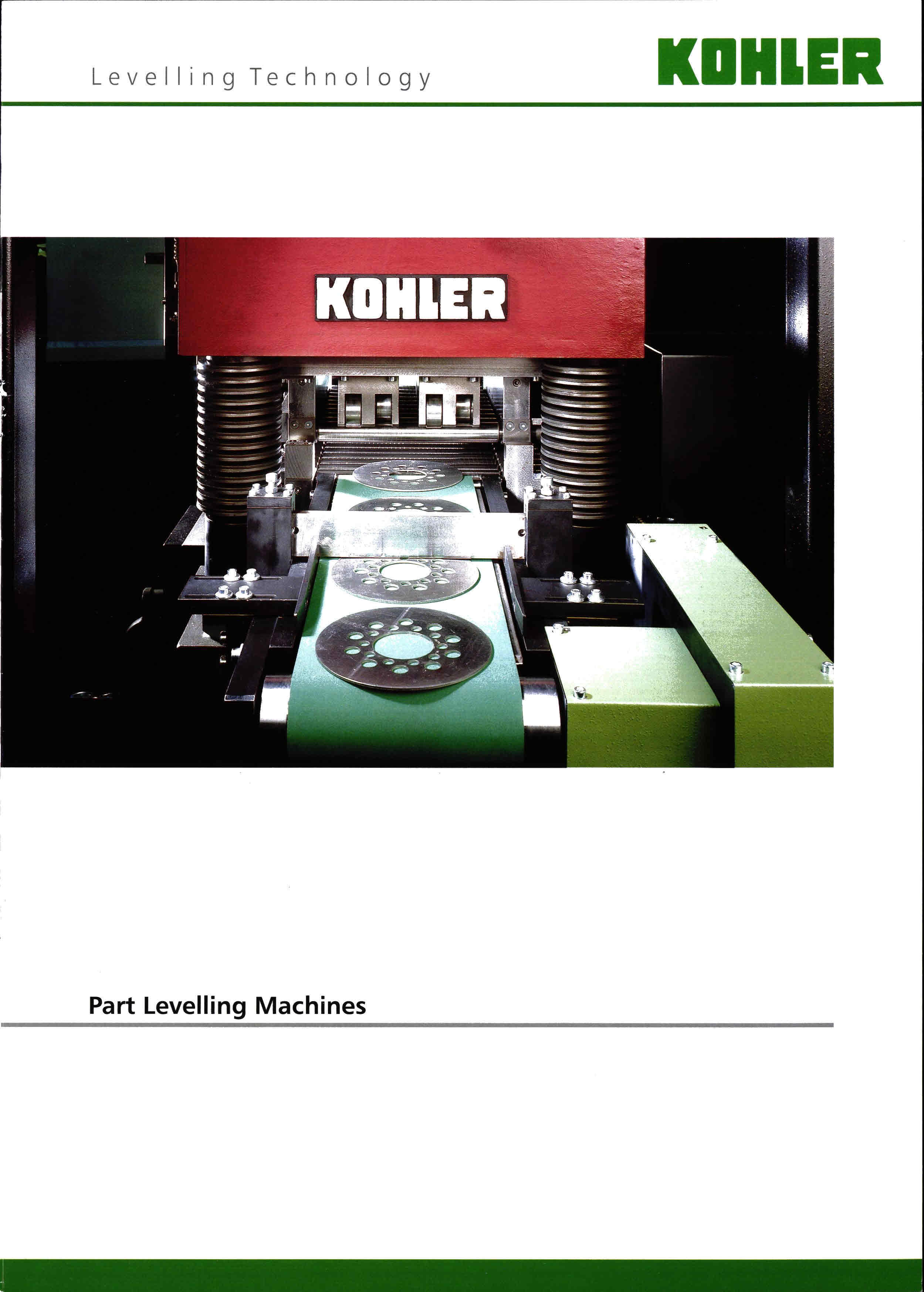
Kohler part levelling machine
Levelling Technology
Part Levelling Machines Part Levelling Machines Range of Application of Range of parts Part Levelling Machines Parts with a thickness from to mm, a width of up to mm and up to mm in length Steel, copper, aluminium, titanium, special alloys, and bimetals up to a yield point of N/mm2 at normal temperature and up to a hardness of HRC Flat parts and parts with uneven surface Parts for device engineering, machine, aircraft, and automotive industry Parts for electrical engineering and the construction industry Basics Saws and cutting tools Sheet-metal parts showing uneven surfaces lead to poor weaving lamella, housing parts, perforated plates quality of the final products. In addition, these parts cause higher costs due to subsequent processing and assembling. Unevenness of the parts results from processing methods such as shearing, stamping, nibbling, laser or plasma cutting, hardening, and coating caused by changes of internal stresses of the component. Roller Levelling The highest degree of surface evenness can be achieved, and internal stresses are reduced remarkably when levelling the parts with a precision leveller. The individually driven levelling rollers level the workpieces through alternate bending. The upper and lower rows of rollers are arranged offset to each other, forming a wedge-shaped profile which opens in running direction. The strongest bending of the material occurs at the inlet where the material is formed until it reaches its plastic state. At the outlet, the workpiece is only formed to its elastic state, leaving the machine with an even surface. Part Levelling Tandem Levelling When running through the precision leveller, the parts are Round parts are always levelled in two levelled to the requested evenness during one levelling most economical solution for series production such as run. The parts are fed and discharged from the precision clutch disks is a tandem levelling machine. This double levelling machine by means of conveyor belts or roller levelling line consists of 2 precision part levelling units paths. In case very big pieces are processed, a second connected by a turntable. Between the two levelling levelling run might be required. To guarantee easy sequences, the turntable turns the parts by 900. handling, the machine should be equipped with a reversing system. The change of direction as well as the setting of the roller frame in opposite direction are carried out case very big pieces are processed a second levelling run might be required. To guarantee easy = handling, the machine should be equipped with a = reversing system. The change of direction as well as the setting of the roller frame in opposite direction are carried out automatically.
Part Levelling Machines Part Levelling Part Levelling Machines Technology KOHLER part levelling machines are designed in various sizes. For further technical data please see our list regarding the machine types available. These machines have very short delivery times. Special machines built to the customer's needs are designed on request. Specially designed machine for levelling high-tensile molybdenum plates with a thickness of up to mm. Quick-Change Device For time-saving cleaning or replacement of levelling and supporting rollers, the rollers are mounted in pull-out roller frames. All levelling rollers, supporting rollers, and intermediate rollers can be reached easily. According to the size of the machine, the pulling out of the roller frame is carried out manually, via spindle, or hydraulically. The threading of the levelling rollers is carried out automatically via spring-loaded clutch. Disc Roller Paths For the transport of annealed parts, a specially designed disc roller path is used. Precision Part Levelling Centering Device For precision levelling machines with 13 to 21 rollers, the The centering device leads parts are optimally positioned into the leveller adjusted by motor via worm gearing with an accuracy of mm. A high- regarding the quality of the material surface are made. These intermediate rollers are driven by means of a universal shaft. Lubrication An oil circuit lubrication supplies the universal shafts Ro11er support with oil. The bearings of For avoiding any bending during the levelling the levelling rollers are process, the support of the levelling rollers by lubricated by grease and means of supporting rollers provides a constant sealed. levelling gap profile. Roller Bending Centre buckles and edge waves on sheet-metal blanks are eliminated by means of roller bending. Therefore, the roller supports of the lower roller frame are individually adjustable in cross-tipping of the upper roller frame supports, this process is controlled by means of the screen graphics. Roller Frame The roller frame is the tool of the levelling machine. The quality of the levelling result depends on precision and stiffness of the roller frame. Roller frames are manufactured and assembled with an accuracy of 1/100 mm.
Intermediate rollers, spirally grooved Intermediate rollers are used when processing parts with delicate surfaces and where high the quality of the material surface are made. These intermediate rollers are spirally grooved for preventing any marking of the the material due to the supporting rollers. In addition, intermediate rollers increase the service life of the levelling rollers as they clean the levelling rollers.
Technical data
Other machine types on request